口座開設
QRコードでアプリをダウンロードする
iOS & Android

Filecoin (FIL)

$
$ 0.73 (FIL/USD)
-1.84%
24H

Filecoin ライブ価格データ

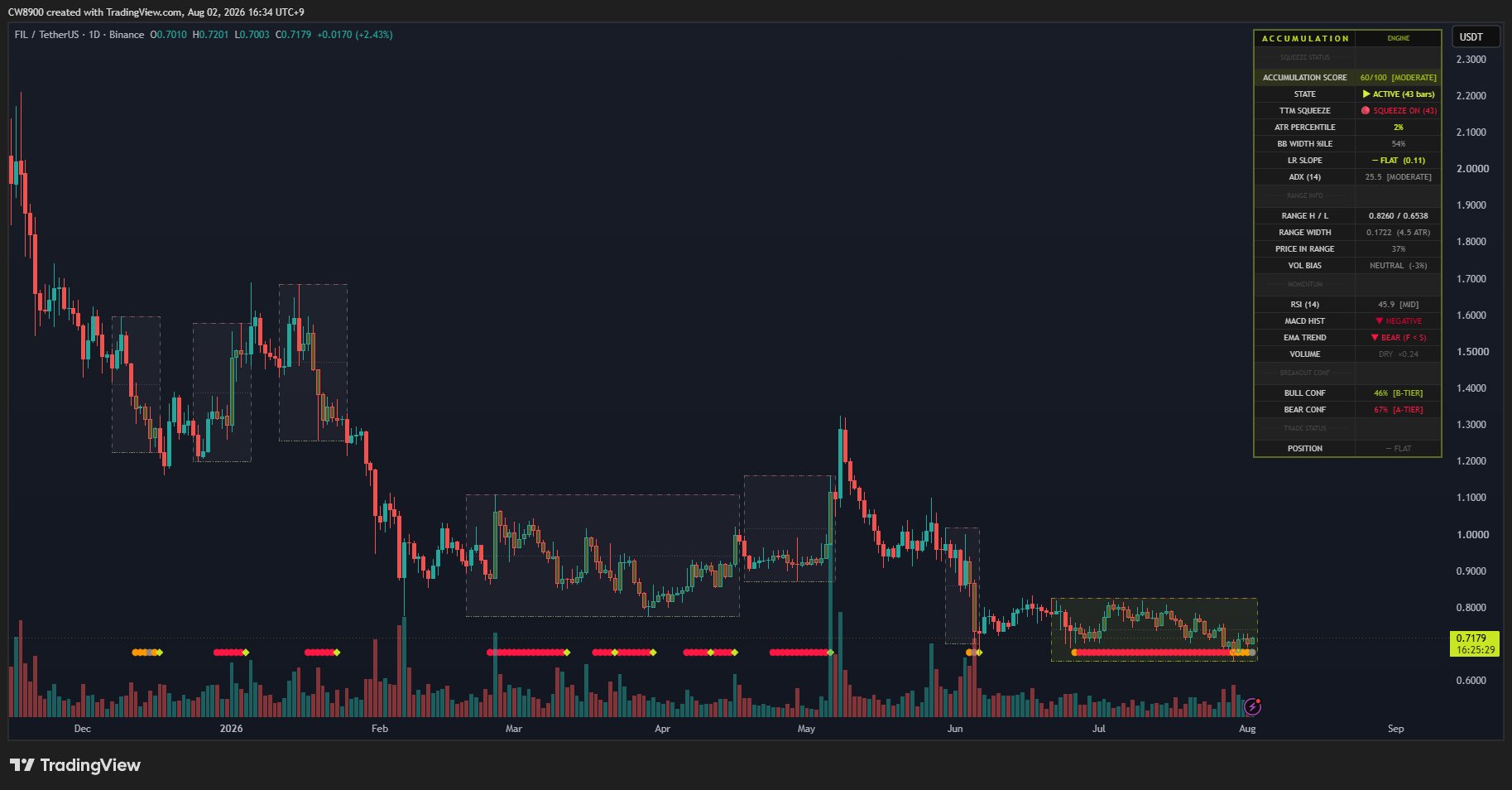
Filecoinの今日の価格は$ 0.73 (FIL/USD)です。 時価総額$ 584.74M USD 24時間取引量$ 3.20M USD 24時間の価格変動-1.73% そして流通供給量790.85M FIL

Filecoin FIL 価格履歴 USD

Filecoinの今日、7日間、30日間、90日間の価格を追跡
期間
24H変動幅
24H変動率 (%)
本日
$ 0.013
-1.84%
7日
$ 0.039
-5.12%
30日
$ 0.29
-28.83%
90日
$ 0.10
-12.74%

FILを今すぐ所有

BitMartでFILを簡単に安全に売買できます。
今すぐFILを購入/売却
今すぐ{0}を購入/売却
Filecoin 相場情報
最終取引価格 $ 0.73
$ 0.73 24H変動幅 $ 0.75
過去最高値
‎$ 237.21‎
過去最安値
‎$ 0.62‎
24H変動幅
‎-1.72%‎
24H取引高
‎$ 3,196,395.77‎
供給量
0.79B FIL
時価総額
‎$ 584.74M‎
最大供給量
--
完全希薄化後時価総額
‎$ 1.45B‎
取引 FIL

稼ぐ

眠っている暗号資産を活用し、セービングやステーキングで安定収益を獲得。
今すぐ試す
今すぐ試す

Filecoin Xインサイト

avatar
Filecoin and other decentralized storage solutions are encountering new opportunities in AI cold data management.

AI storage is booming—can Filecoin step in to pick up the junk? — What is hot tiering, cold storage??

Preface: Filecoin hasn't sought partnerships for years, and Juan has become reclusive. I write about Filecoin because I have a neighboring Filecoin whale, Kang Ge @tktang88, and many big Filecoin miner friends who constantly share knowledge and future expectations about Filecoin. In particular, a point Kang raised this time caught my interest.

Thus this tweet was born—not a commercial advertisement, nor an encouragement to buy $FIL, but a new perspective on decentralized storage.

Main text

Two days ago, Micron's earnings outlook cast a shadow over the market; yesterday, better-than-expected results triggered a short‑term rally, even pushing Micron's market cap above Meta and Tesla. The driver is that AI‑era storage demand may exceed many people's imagination.

AI training and inference require high‑speed read/write; vector databases, KV cache offloading, model parameters, and intermediate inference states need stronger memory and storage capacity. This is a hardware‑level logic, more deterministic, and revenue is more direct.

However, AI storage demand will not stay limited to high‑speed memory and SSDs. As model training, inference, agents, and user‑generated content increase, another troublesome class of data will emerge: large amounts of short‑term valueless data with extremely low access frequency, possibly never needed again, yet companies are reluctant to delete it.

That's the focus of today's discussion—storage of junk data!

Data in the AI era is naturally tiered. At the front are hot data, currently used for training and inference, requiring high‑speed access, dominated by HBM, DRAM, NVMe SSDs, and high‑speed networks.

In the middle are warm data, potentially reusable in the near term, such as model checkpoints, training shards, vector indexes, experiment logs, evaluation data, and datasets still under iteration.

Finally, cold data—already completed training and not called upon in the short term, but may be needed later due to re‑training, rollbacks, copyright, regulation, audit, security incidents, or model reproducibility.

Notably, cold data falls outside Micron's current focus. Micron dominates high‑speed storage used for training and inference. This data has the highest value and price, making the necessary hardware scarce.

Cold data, on the other hand, is used extremely infrequently—original training data, cleaned data, deduplication logs, annotation records, early user‑generated images and videos—essentially considered junk. Most of these are never opened again, perhaps not read for years, yet cannot be simply deleted.

Because future re‑training, model rollbacks, output explanations, copyright disputes, regulatory audits, or simply new models may render previously useless data valuable.

Thus, the biggest headache in the AI era is the growing volume of data and increasing risk associated with deleting it.

Many early‑stage AI businesses manage data coarsely, without separating hot, warm, and cold tiers. Especially low‑frequency data occupying high‑cost storage is uneconomical in the long run, dramatically increasing storage costs. Using high‑speed cloud storage is even less viable. So, can we just toss these cold data into a hard‑disk ‘cold warehouse’?

The answer is no.

If AI data is merely dumped into a cold warehouse without indexes, tags, provenance, model‑version mapping, or cleaning process logs, the data is essentially lost even if it physically remains.

What’s needed is hot metadata and cold data bodies. The data bodies can reside in cold storage, but the directory, provenance, hash, CID, license, creation time, cleaning method, associated model, usage logs, privacy tags, retention period, and recovery test results must reside in a searchable, readable, auditable hot index layer.

This is why Filecoin and decentralized storage can be revisited—especially those with network storage capabilities.

Filecoin offers massive network storage capacity; while having many disks alone isn’t significant, the disks on the blockchain already form a prototype of verifiable cold storage. Filecoin’s distinctive features compared to traditional cloud storage are content addressing, multi‑provider storage, and on‑chain proof.

In plain terms, customers don’t have to trust a single cloud provider’s claim that “the data is stored”; they can continuously verify that the data remains unchanged and can be retrieved later via the same content identifier.

This capability is meaningful for AI cold data.

From this perspective, the real opportunity for decentralized storage may be the AI cold‑data management layer: migrating data from training clusters, cloud object storage, and on‑prem servers, performing deduplication, compression, privacy scanning, copyright tagging, encryption, and sharding, then placing large files into cold storage while retaining a hot index.

When a model needs re‑training, the system can retrieve data by source, time, tags, and model version. Without this ability, Filecoin is merely a warehouse; with it, decentralized storage could become part of AI data infrastructure.

Different decentralized storage projects should be evaluated separately. Filecoin is better suited for verifiable cold data warehouses, as its core is the storage market and data proofs, fitting large files, low‑frequency access, version‑stable dataset snapshots, model checkpoints, research data, public training corpora, and privacy‑processed audit logs.

Arweave is better for permanently public data, model documentation, data provenance records, immutable public archives, but data involving privacy or the right to delete is hard to store there due to compliance issues.

Storj and Sia are closer to decentralized object storage; if the user experience and pricing are competitive, they can capture some backup and archival needs, but they must also prove availability, recovery speed, enterprise services, and long‑term economic models.

Of course, the most important factor is being cheap enough.

AWS Glacier Deep Archive, Google Archive, Azure Archive, enterprise tape libraries, on‑prem object storage, disk manufacturers, and cloud providers will all vie for AI cold data.

Especially for ultra‑low‑frequency data, tape and deep archive remain competitive. Decentralized storage must first be cheap, but also meet verifiability, multi‑provider, vendor neutrality, and content addressing. Cheapness is only a door opener.

As AI continues to evolve, cold or junk data will increase, potentially becoming one of the biggest cost headaches for AI companies.

That’s why I believe the existing, cheap decentralized storage solutions deserve renewed discussion.

Historically, projects like Filecoin had supply (miners) but lacked real demand. There are many disks and storage providers on the network, and a decentralized narrative, yet real customers and paying users are virtually nonexistent.

If AI cold data becomes a large market and decentralized storage can deliver “hot index, cold storage” cheaper than traditional solutions, those existing disks could see real use.

From an investment perspective, Micron’s rise doesn’t automatically imply Filecoin should follow; their business models are entirely different.

Micron sells hardware; Filecoin’s value depends on paid storage volume, genuine customer count, renewal rate, retrieval success rate, restoration cost, storage provider profit, and whether this growth translates into $FIL demand, staking, fees, or burns.

Decentralized storage still has a long way to go, especially in implementing a functional “hot index, cold storage” system; that’s where Filecoin projects need to focus.

AI cold‑data demand is likely to materialize, but where it ends up will depend on who can be cheap enough, stable enough, searchable enough, and auditable enough.

If Filecoin can only prove it has many disks, that’s not very meaningful.

If Filecoin can demonstrate that these disks can handle real paid data and retrieve it reliably years later, with full restoration and sustained renewals, then the seemingly unwanted junk data of the AI era could indeed give decentralized storage a second chance.

End

avatar

@tktang88 It's not guaranteed that a text with many characters was written by AI. https://t.co/tkxceqHy2A

view 40
view 32
view 36.5K
2026-06-26 08:57
リリース後のFILのトレンド
強気
Filecoin and other decentralized storage solutions are encountering new opportunities in AI cold data management.
avatar
FIL has tumbled 99.72% from its ATH, warning of the risks of buying at high levels and a prolonged bear market.

Imagine Buying $FIL At The Top, It's Now Down 99.72% From Its ATH, Wiping Out Nearly Everything In Just 5 Years.

@Filecoin https://t.co/QO6HVQCytO

view 223
view 15
view 6.5K
2026-06-24 16:37
リリース後のFILのトレンド
非常に弱気
FIL has tumbled 99.72% from its ATH, warning of the risks of buying at high levels and a prolonged bear market.
avatar
FIL July FIP‑16 upgrade is imminent, expecting network speedup bullish
avatar

Who is ready for the FIP.16 effect after July?! 😤☀️

view 106
view 5
view 4.8K
2026-06-21 02:52
リリース後のFILのトレンド
強気
FIL July FIP‑16 upgrade is imminent, expecting network speedup bullish
詳細確認

価格予測

FILを購入するのに良い時期はいつですか?FILは今買いでしょうか、売りでしょうか?

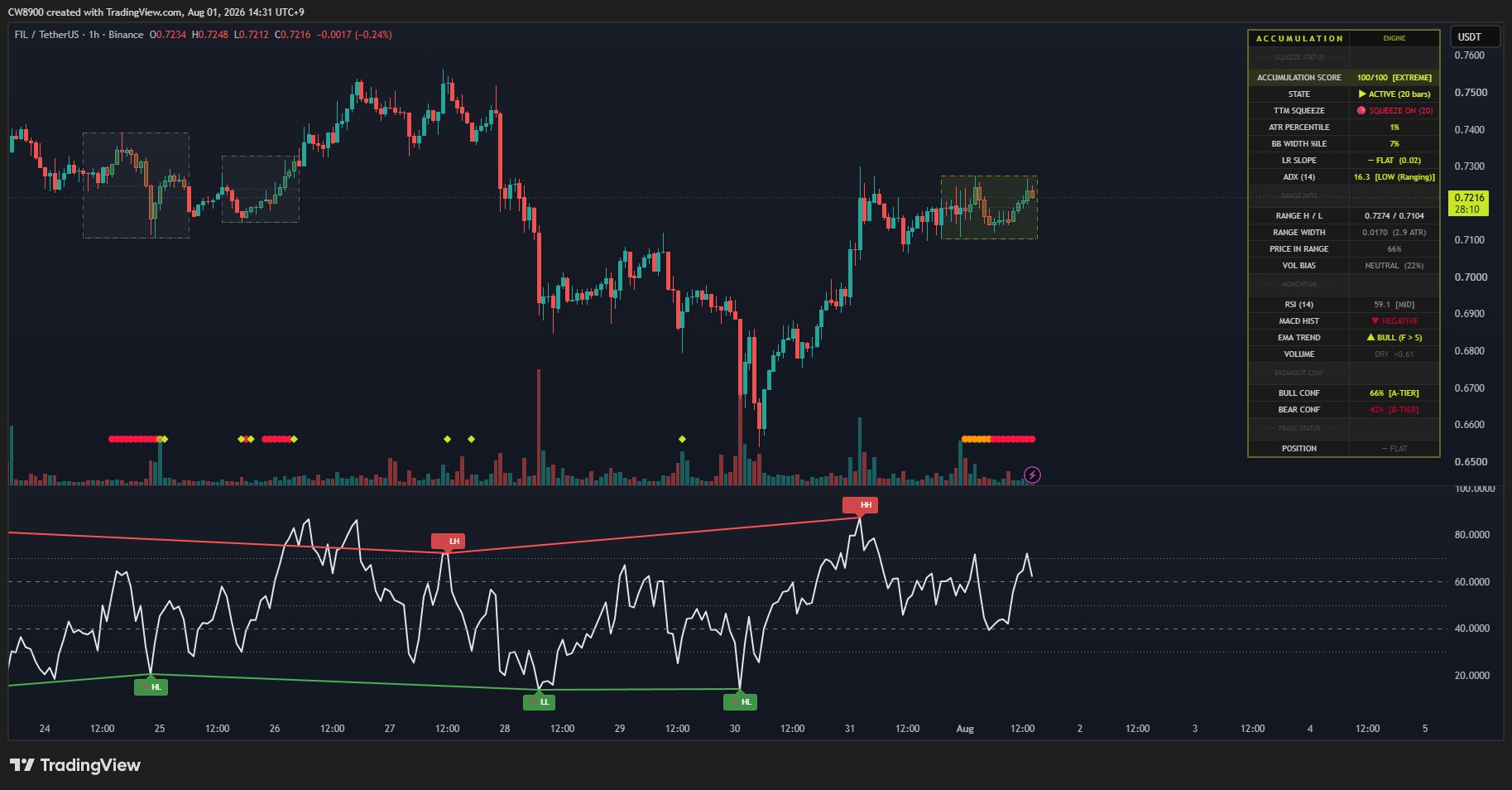
Filecoin(FIL)を購入または売却する適切な時期を決定する際は、まずご自身の取引戦略とリスクプロファイルに合わせることが重要です。長期投資家と短期トレーダーは市場状況を異なる方法で解釈することが多いため、決定には個人的なアプローチを反映すべきです。 最新の FIL 4時間テクニカル分析によると、現在の取引シグナルは ホールド です。 最新のFIL1日テクニカル分析によると、現在のシグナルはホールドです。
40
ホールド
FILの4時間テクニカル分析
最終更新 2026-06-27 15:59:59
53
ホールド
FILの1日間テクニカル分析
最終更新 2026-06-28 00:00:00
beacon

ビーコン予測

の確率的価格予測(今後24時間)
i
ビーコン予測に関する免責事項
このページに表示されるデータ結果は、選択した取引ペアの実際の取引データ(OHLCV)と対応するテクニカル指標に基づいて分析されています。
この予測は実験的な技術的成果であり、あくまで参考目的で提供しています。これは投資アドバイスをではありません。現実世界での予期せぬ出来事が市場行動に大きな影響を与える可能性があります。トレーダーは慎重に意思決定を行うべきです。
アプリバージョン Filecoin
Filecoin (FIL) is a cryptocurrency launched in 2020. Users are able to generate FIL through the process of mining. Filecoin has a current supply of 1,957,686,173 with 790,854,566 in circulation. The last known price of Filecoin is 0.81270139 USD and is up 3.22 over the last 24 hours. It is currently trading on 705 active market(s) with $66,368,856.86 traded over the last 24 hours. More information can be found at https://filecoin.io/.
続きを読む
購入 FIL
取引 FIL