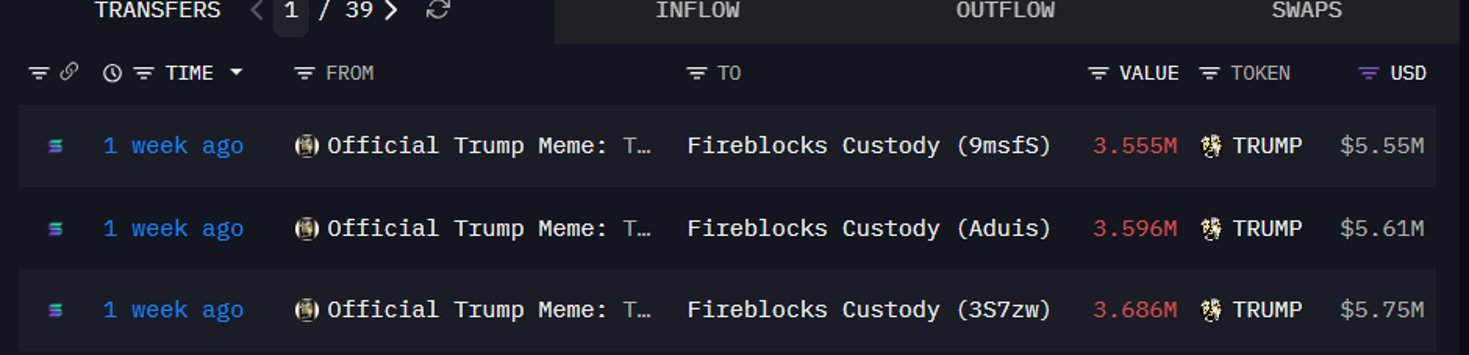
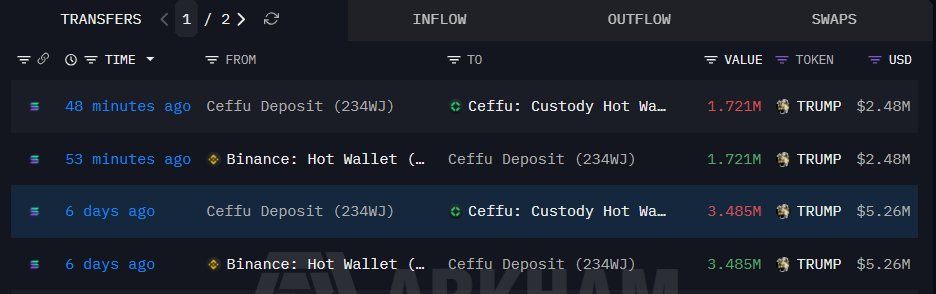
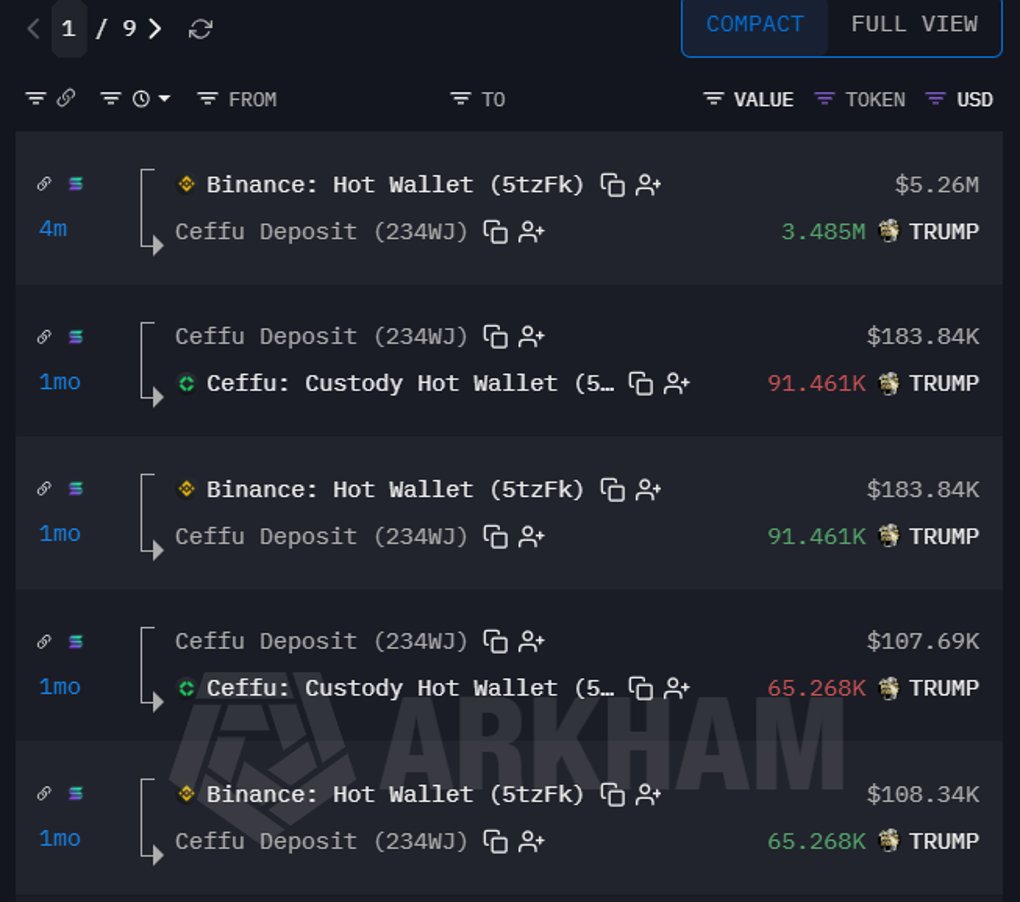
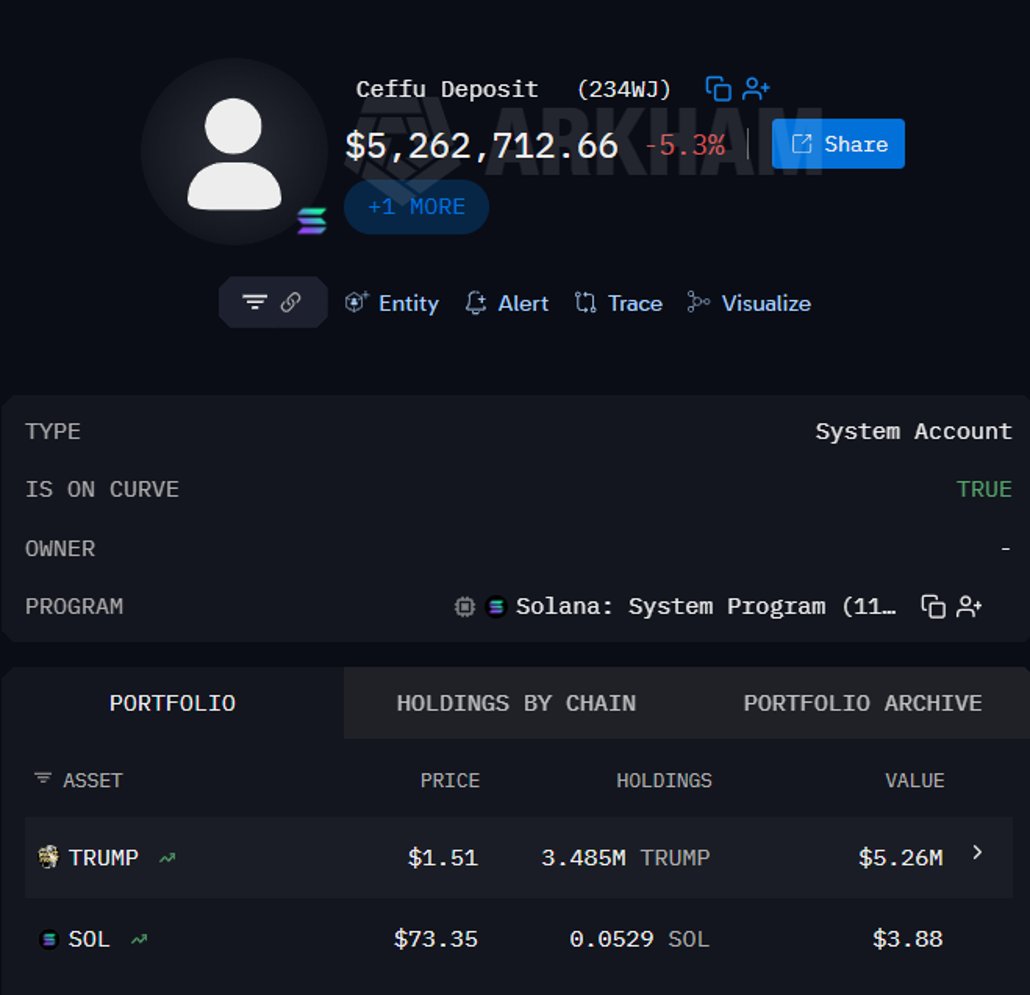
$TRUMP = 98% down
Go figure. https://t.co/pyomAKUrnd
$TRUMP = 98% down
Go figure. https://t.co/pyomAKUrnd
JUST IN: 🇺🇸 President Trump made over $500,000,000 from the sale of tokens created by his family's crypto company.
Great job! 👏👏👏
I analysed the 900+ pages of the Trump financial disclosure report.
He extracted 1.1 BILLION from crypto, divided like this:
> $635.1M → TRUMP memecoin
> $236.3M → WLFI token sales
> $196.9M → Sale of ownership interests in the USD1 stablecoin venture
> $65.6M → Sale of part of Trump's stake in World Liberty Financial
> $6.0M → Melania Trump's NFT sales and collectibles business
> $1.82M → Ethereum validator (staking) rewards
The biggest scammer of all time
From the existing public information, Trump's earning money through cryptocurrency may not necessarily be illegal, but the ethical, conflict-of-interest, and political-corruption perception issues are significant.
First, Trump and his family making money from crypto projects is not inherently illegal.
A U.S. president may retain private assets and hold commercial interests through trusts, including cryptocurrency.
Second, a regular federal official who participates in government matters that affect his own financial interests could trigger the criminal conflict-of-interest rule at 18 U.S.C. §208.
The Office of Government Ethics (OGE) interprets this rule to mean that government employees may not personally or substantially participate in official matters in which they have a financial interest. However, the president and vice-president are treated specially; the CRS interpretation of executive-branch conflict-of-interest rules explicitly states that 18 U.S.C. §208 does not apply to the president or vice-president.
That is the most critical point.
There is a large legal vacuum for the president. Therefore, Trump can simultaneously promote stablecoin regulation and crypto policy while his family profits from stablecoins, meme coins, and the World Liberty project. Although it looks like a conflict of interest to a layperson, OGE's rules do not deem it a conflict. One could say Trump is a very shrewd businessman who knows how to find loopholes, but it is not illegal.
Third, potential legal issues arise.
If a foreign government, sovereign wealth fund, or royal-backed capital directly or indirectly purchases Trump-related crypto assets or project equity, or provides benefits to Trump’s family projects, it could run afoul of the U.S. Constitution’s Foreign Emoluments Clause.
Under the Constitution, any U.S. officeholder may not, without congressional consent, accept gifts, compensation, positions, or titles from foreign monarchs, princes, or foreign states.
Thus, projects such as World Liberty, USD1, and TRUMP are not necessarily illegal per se, but if the buyer includes foreign-government capital or the transaction price is clearly not at arm’s-length market value, legal risk emerges.
Fourth, securities law and investor-protection risk points.
World Liberty’s website and materials disclose that the Trump family will take the majority of token-sale revenue, and the materials also contain a disclaimer stating that the tokens are not investments and buyers should not expect profit; the TRUMP meme-coin website carries similar warnings.
However, if investors prove that the project engaged in misleading marketing, concealed benefit arrangements, market manipulation, or false statements, civil litigation or regulatory investigation could ensue. So far, profitability alone does not make the project illegal.
Fifth, stablecoin compliance depends on whether the project meets the regulatory requirements after the GENIUS Act.
The GENIUS Act established a federal regulatory framework for payment stablecoins and requires that issuers of payment stablecoins in the United States be approved issuers. Bank subsidiaries and federally qualified non-bank issuers are subject to corresponding supervision.
If USD1 or related stablecoin business complies with the regulatory requirements, the business itself may be legalized; if, after the regulation is enacted, the business lacks compliance qualifications or circumvents regulation through structure, new problems arise.
Therefore, from a legal standpoint, one cannot say that Trump’s crypto income is illegal.
But from a political-ethical perspective, the matter looks very unattractive.
Especially when Trump says the United States should become the world’s largest crypto-currency nation, the market hears policy benefits and regulatory relaxation, the project receives presidential endorsement, and Trump and his family-related entities profit in the process—this is hard to explain as a “normal commercial activity.”
@PhyrexNi Is this money earned legally?