شراء العملات المشفرة
بطاقة
تداول P2P
اشتر USDT عبر السوق
بطاقة الائتمان/الخصم
اشترِ العملات المشفرة باستخدام Visa أو Mastercard
الدفع من جهة خارجية
اشترِ العملات المشفرة عبر MoonPay و Simplex والمزيد
بطاقة بيتمارت
تعزيز قدرات حياتك في مجال العملات المشفرة
بطاقة مسبقة الدفع للعملات المشفرة
احصل على بطاقة ماستركارد صالحة للاستخدام فورًا
Rewards
السحب اليومي للحسابات الآجلة
فرصة ربح مضمونة بنسبة 100% مع التداولات اليومية
السحب اليومي لحساب فوري
اكسب 8888 USDT في الجوائز الكبرى
شحن رصيد الهاتف المحمول
شحن الرصيد بسهولة، عبر الإنترنت، وبأمان
Send
Send money globally, fast and secure
BitMart Mall
بث مباشر للعملات المشفرة

Lido wstETH (WSTETH)
$ 3,343.80 (WSTETH/USD)
-0.03%
24H
Lido wstETH بيانات الأسعار المباشرة
سعر اليوم لـ Lido wstETH هو $ 3,343.80 (WSTETH/USD). بقيمة سوقية تبلغ $ 12.72B USD. حجم التداول خلال 24 ساعة لـ $ 3.61M USD، تغير السعر خلال 24 ساعة بمقدار -0.03%، وإمداد متداول قدره 3.81M WSTETH.
Lido wstETH WSTETH سجل الأسعار USD
تتبع سعر Lido wstETH لليوم، و7 أيام، و30 يومًا، و90 يومًا
الفترة
تغير
التغير (%)
اليوم
$ 0.83
-0.03%
7أيام
$ 97.97
3.01%
30أيام
$ 248.72
8.02%
90أيام
$ 1,140.31
51.58%
امتلك WSTETH الآن
اشترِ وبع WSTETH بسهولة وأمان على BitMart.
Lido wstETH معلومات السوق
$ 3,331.94 مدى 24سا $ 3,352.05
أعلى مستوى على الإطلاق
$ 6,451.42
أدنى مستوى على الإطلاق
$ 894.10
تغير24سا
-0.03%
حجم 24سا
$ 3,612,770.74
الإمداد المتداول
3.80M
WSTETH
القيمة السوقية
$ 12.73B
الحد الأقصى للإمداد
--
القيمة السوقية المخففة بالكامل
$ 12.73B
التداول WSTETH

Lido wstETH رؤى X

Bubbafox
FA_Analyst
Influencer
B
 26.4K @bob4punk
 محايد
CCIP transfers $13.1M, wstETH leads, encourages staking LINK.

CCIPMetrics D
3.8K @CCIPMetrics #CCIP today
Value transferred: $13,148,079.2
Top sent token: $wstETH @LidoFinance: $3,513,052.7 (26.7%)
Transactions: 1,820
Fees: $1,916.9
Top sender: @Predictstreet: Tx: 872 (47.9%), Fees: $1,431.8 (74.7%)
Pools open. Stake your LINK today at https://t.co/yhMFfpGi0K
 124
124
 9
9
 6.0K
6.0K
2026-07-12 00:57
اتجاه WSTETH بعد الإصدار
محايد
CCIP transfers $13.1M, wstETH leads, encourages staking LINK.

StakingCabin
OnChain_Analyst
Tokenomics_Expert
B
2.8K @stakingcabin صاعد
wstETH can be bridged to Robinhood, continuing to earn ETH staking rewards
One of the biggest challenges in DeFi is fragmented liquidity.
By enabling wstETH to move to Robinhood Chain while continuing to accrue staking rewards, capital can flow into a new ecosystem without sacrificing its underlying yield.

Lido D
228.8K @LidoFinance Staked ETH, meet Robinhood Chain.
Your wstETH can now cross over to @RobinhoodCrypto, carrying its Ethereum staking rewards with it and unlocking a new ecosystem to put it to work in.
↓ https://t.co/23u0Vlp9rE
1
0
110
2026-07-07 14:27
اتجاه WSTETH بعد الإصدار
صاعد
wstETH can be bridged to Robinhood, continuing to earn ETH staking rewards

Mars_DeFi
Researcher
Educator
B
26.2K @Mars_DeFi متصاعد بقوة
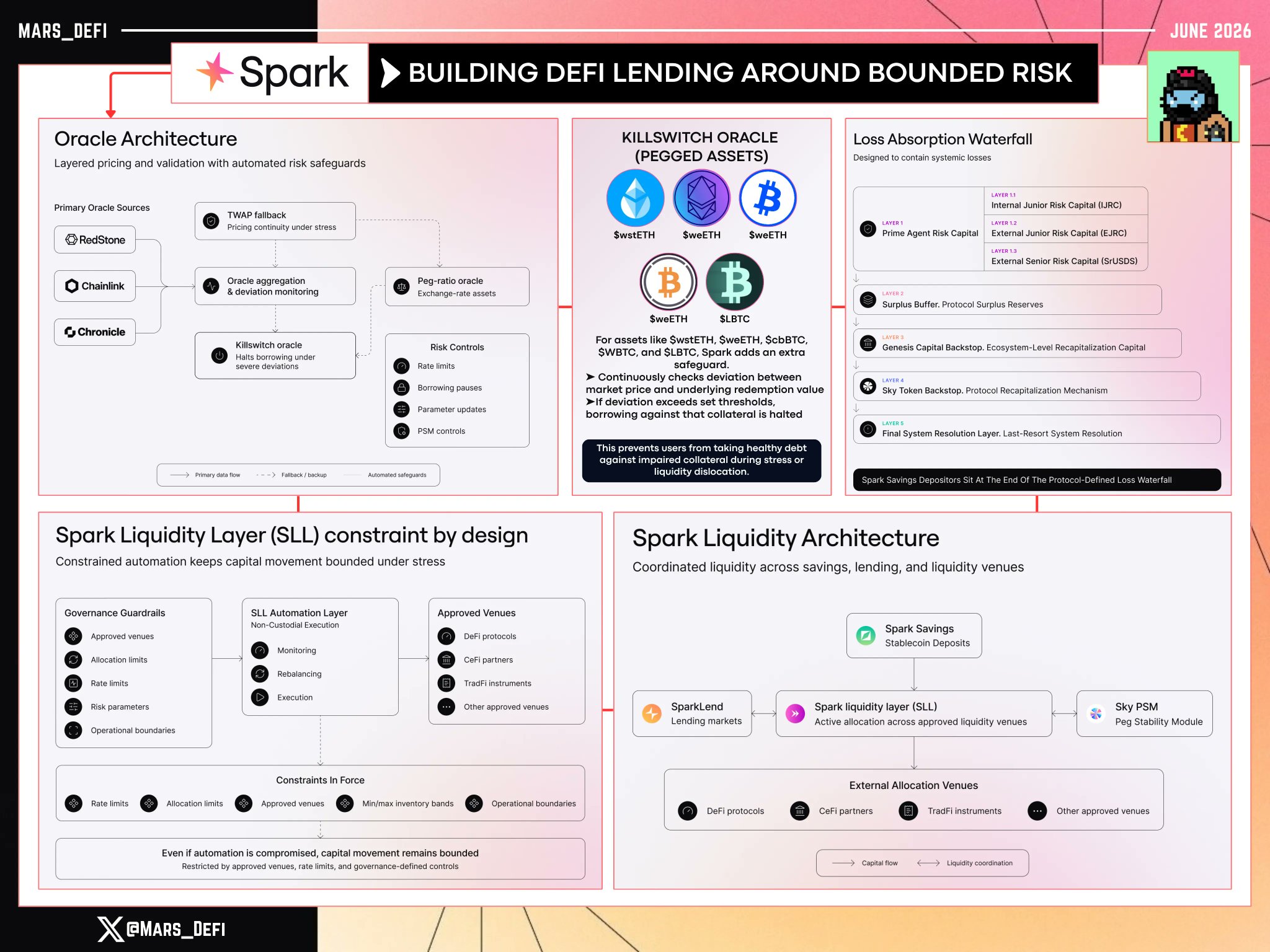
Spark builds a safe and robust DeFi lending infrastructure through multi‑layer risk control, oracles, and liquidity management.
Most lending markets optimize for liquidity and capital efficiency first, then try to manage risk after the fact while @sparkdotfi ’s security/risk framework is one of the better examples of where DeFi lending is heading.
The whole architecture is built around bounded risk, controlled capital movement, layered loss absorption, oracle redundancy, and stress-response mechanisms.
Here’s how Spark does it.
—
Spark keeps a deliberately narrow collateral set, which reduces exposure to fragmented liquidity, weak redemption assumptions, and long-tail collateral risk.
Instead of trying to list every possible asset, it prioritizes predictable liquidation behavior and deeper market structure during stress.
For assets with more unique or chain-specific risks, Spark uses isolated markets. That means risk can be priced more precisely per collateral type, and a single collateral issue does not automatically contaminate the broader pool.
—
The oracle setup is also important.
Spark uses a three-oracle median system drawing from @redstone_defi , @chainlink , and @ChronicleLabs oracle.
When all three return valid prices, the median is used. If only two valid sources are available, the average is used, with fallback logic under degraded conditions.
That reduces dependency on any single oracle provider.
For pegged or exchange-rate assets like $wstETH, $weETH, $cbBTC, $WBTC, and $LBTC, Spark adds another layer through a killswitch oracle.
• This continuously checks whether market pricing is diverging from the underlying exchange-rate or redemption value.
• If deviation passes predefined thresholds, Spark can halt new borrowing against that collateral.
That is a very important safeguard because it prevents users from borrowing healthy debt against impaired collateral during periods of stress, liquidity fragmentation, or pricing dislocation.
—
The liquidity architecture is another strong part of the design.
Spark’s Liquidity Layer is not just idle capital sitting passively in a pool. It coordinates liquidity across Spark Savings, SparkLend, the Sky PSM, and other approved venues.
But the key part is that this liquidity movement is constrained by design.
All venues must be pre‑approved by governance. Capital movement is subject to;
• allocation limits
• rate limits
• min/max inventory bands
• risk parameters
• operational boundaries
Spark’s framework is built around controlled risk, not unlimited automation.
Capital can only move through approved venues, rate limits, allocation limits, and governance‑defined boundaries. So even if automation fails, the damage is contained.
The same idea applies to losses.
Before depositors are affected, losses pass through multiple buffers: risk capital, surplus buffer, Genesis Backstop, SKY backstop, and final resolution.
Spark Savings also has 1:1 USDS backing, liquidity buffers, fast withdrawal routing, real-time transparency, Credora risk reviews, and limited bridge exposure.
—
Overall, the theme is simple:
Spark is not just chasing higher yields.
It is building DeFi credit infrastructure around constrained liquidity, layered protection, and limited blast radius.

Spark D
69.7K @sparkdotfi Inside Spark’s loss absorption & risk frameworks.
Spark’s security architecture is designed around:
• bounded capital movement
• explicit loss absorption layers
• coordinated liquidity management
• multi-layered oracle systems
• constrained automation under governance-defined limits
This deep dive breaks down how Spark structures risk, liquidity, and loss absorption across Spark Savings, SparkLend, and the Spark Liquidity Layer before losses propagate toward user deposits.
Including:
• updated loss absorption waterfall
• Prime Agent risk capital
• Genesis Capital Backstop
• oracle and killswitch architecture
• programmatic liquidity coordination
• constrained allocation design under stress
Security by design.
Resilience by architecture.
See what sits between losses and user deposits: https://t.co/JQrfSxMB4z
30
18
1.7K
2026-06-03 14:12
اتجاه WSTETH بعد الإصدار
متصاعد بقوة
Spark builds a safe and robust DeFi lending infrastructure through multi‑layer risk control, oracles, and liquidity management.
توقع السعر
متى يكون الوقت المناسب لشراء WSTETH؟ هل يجب أن أشتري WSTETH أو أبيعه الآن؟
عند اتخاذ قرار ما إذا كان الوقت مناسبًا للشراء أو البيع Lido wstETH (WSTETH)، من المهم أولاً أن تتوافق مع إستراتيجيتك الخاصة في التداول وملف المخاطر الخاص بك. غالبًا ما يفسر المستثمرون على المدى الطويل والمتداولون على المدى القصير ظروف السوق بشكل مختلف، لذا يجب أن يعكس قرارك نهجك الشخصي. استنادًا إلى أحدث تحليل تقني لمدة 4 ساعات لـ WSTETH، فإن إشارة التداول الحالية هي بيع. وفقًا لأحدث تحليل تقني لـ WSTETH لمدة يوم واحد، فإن الإشارة الحالية هي الحيازة.

توقعات Beacon
توقعات الأسعار الاحتمالية (الـ 24 ساعة القادمة)إخلاء مسؤولية توقعات Beacon
يتم تحليل نتائج البيانات المعروضة في هذه الصفحة استنادًا إلى بيانات التداول الفعلية (OHLCV) لزوج التداول المحدد إلى جانب المؤشرات التقنية المقابلة.
هذا التنبؤ هو منتج تقني تجريبي ويتم توفيره لأغراض مرجعية فقط. ولا يشكل نصيحة استثمارية. قد تؤثر الأحداث غير المتوقعة في العالم الحقيقي بشكل كبير في سلوك السوق. يجب على المتداولين اتخاذ القرارات بحذر.
هذا التنبؤ هو منتج تقني تجريبي ويتم توفيره لأغراض مرجعية فقط. ولا يشكل نصيحة استثمارية. قد تؤثر الأحداث غير المتوقعة في العالم الحقيقي بشكل كبير في سلوك السوق. يجب على المتداولين اتخاذ القرارات بحذر.
حول Lido wstETH
Lido wstETH (WSTETH) is a cryptocurrency launched in 2020and operates on the Ethereum platform. Lido wstETH has a current supply of 3,807,834.45169063. The last known price of Lido wstETH is 3,305.89974941 USD and is up 1.19 over the last 24 hours. It is currently trading on 798 active market(s) with $6,757,557.09 traded over the last 24 hours. More information can be found at https://www.lido.fi.
اقرأ المزيد